
International Commercial Terms (Incoterms®) are standardized trade definitions established by the International Chamber of Commerce (ICC). These rules explicitly define the obligations of buyers and sellers regarding the delivery of goods, cost allocation, and risk transfer. They serve as the universal language for global sales contracts and logistics management.
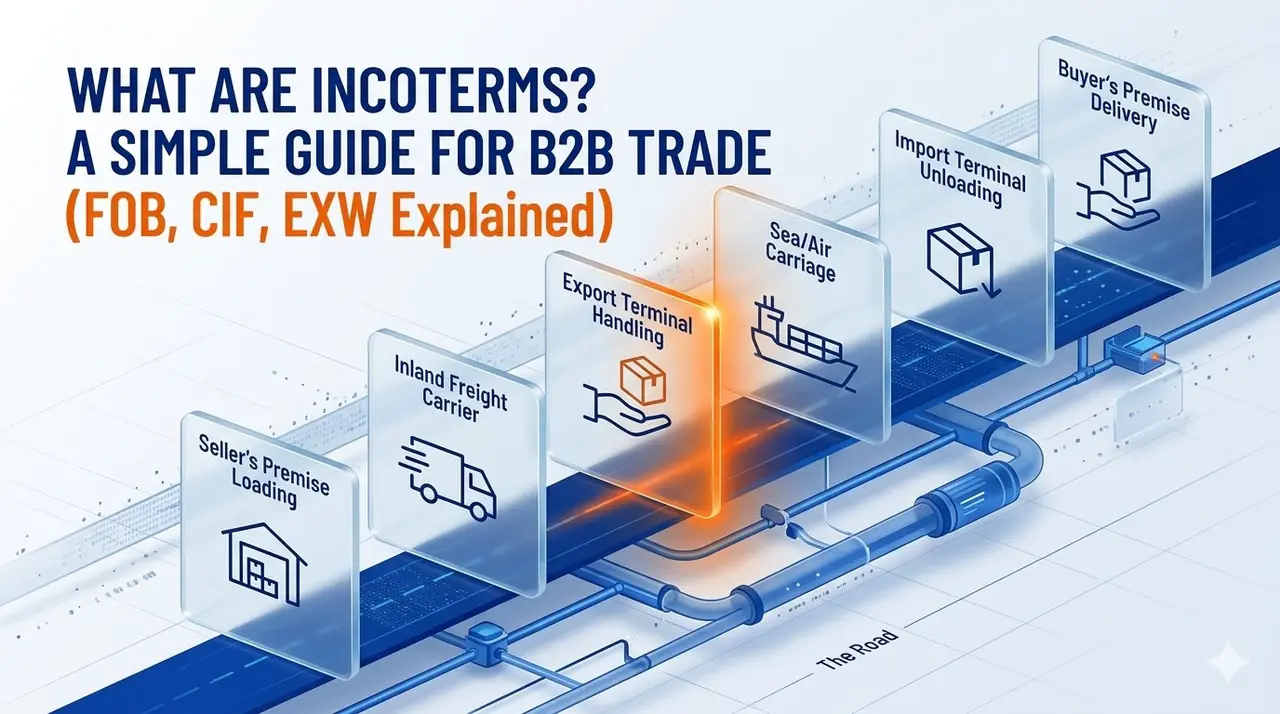
Precision in trade terms directly impacts financial outcomes. According to the United Nations Conference on Trade and Development (UNCTAD), maritime transport handles approximately 80% of global merchandise trade by volume. In this high-volume environment, ambiguous contracts lead to significant supply chain disruptions and unexpected costs. Companies mitigate these risks by selecting the Incoterm that aligns with their logistical capabilities and risk tolerance.
This guide analyzes the three most frequently used terms in B2B trade: EXW (Ex Works), FOB (Free on Board), and CIF (Cost, Insurance, and Freight). We examine the specific points at which liability shifts from the manufacturer to the buyer. This analysis provides the necessary facts for companies to negotiate accurate and compliant international trade agreements.
Contents
Introduction to Incoterms: A Comprehensive Guide
Incoterms® (International Commercial Terms) are globally recognized trade rules published by the International Chamber of Commerce (ICC). These terms explicitly define buyer and seller obligations regarding costs, risks, and delivery points.
First established in 1936, the current Incoterms® 2020 rules standardize responsibilities for modern global supply chains. By clarifying who is responsible for transport, insurance, and customs procedures at each stage of the shipment, Incoterms reduce ambiguity and help prevent disputes in commercial contracts.
Key Functions and Importance
Incoterms® establishes a universal framework for global trade, minimizing ambiguity in commercial contracts. According to the International Chamber of Commerce (ICC), the organization that publishes these rules, Incoterms fulfill three primary functions:
- Obligations: Assign responsibility for specific tasks, including organizing transport, obtaining insurance, and handling customs clearance.
- Risk Transfer: Define the exact physical point where liability for cargo loss or damage shifts from the seller to the buyer.
- Cost Allocation: Determine which party pays for each segment of the logistics chain, from freight to terminal handling charges.
While adoption is voluntary, the U.S. International Trade Administration (ITA) notes that companies universally integrate these codes into purchase orders and shipping documentation. This creates a common trade language, ensuring predictable execution and reducing cross-border disputes.
Limitations of Incoterms
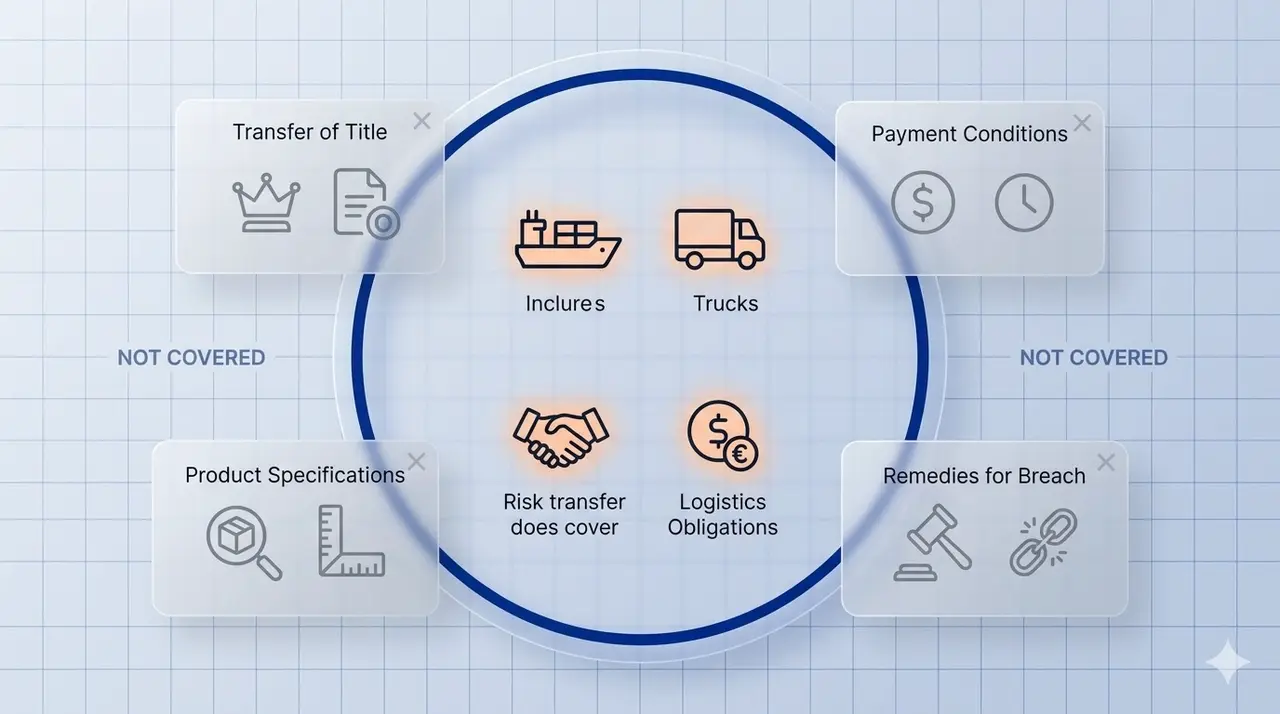
Incoterms® regulate logistics and risk, not the full commercial agreement. Guidance from the ICC and the Canadian Trade Commissioner Service explicitly states that these rules exclude the following critical elements:
- Transfer of Title: The rules define the transfer of risk, not ownership. Legal title passes based on the sales contract, regardless of the shipping term used.
- Payment Conditions: Incoterms do not dictate the contract price, payment methods, or the timing of funds transfer.
- Product Specifications: They do not address the quality, quantity, or physical characteristics of the goods.
- Remedies for Breach: They do not provide legal mechanisms or penalties if a party fails to meet their obligations.
Buyers and sellers must define these variables explicitly within the sales contract to ensure a comprehensive and legally binding agreement.
Alignment with Payment Methods
Incoterms selection directly affects financial security, particularly when using Letters of Credit (LC).
- The EXW Risk: Under Ex Works, the seller does not control transport and may not receive a Bill of Lading (B/L) from the buyer’s carrier. Without a B/L, the seller cannot satisfy LC requirements to collect payment from the bank.
- The F-Group Solution: For LC transactions, sellers should negotiate FCA (handing over to carrier) rather than EXW, or FOB (if sea freight), ensuring they receive the necessary transport documents to trigger payment.
Classification of Incoterms® 2020
The 11 Incoterms® are categorized by the mode of transport. The following seven rules apply to any mode (road, rail, air, sea) or multimodal transport.
Rules for Any Mode of Transport
These seven terms are designed for maximum flexibility and can be used for any mode of transportation, including multimodal journeys involving road, rail, air, and sea.
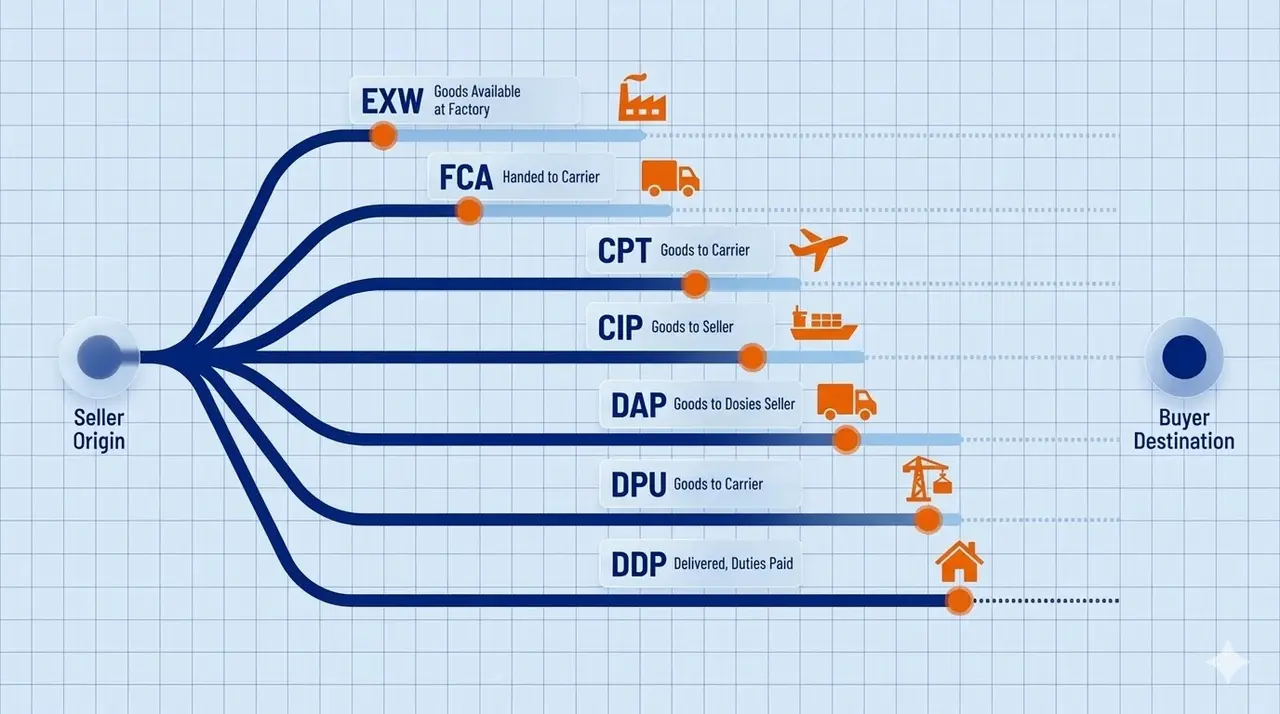
| Incoterm | Responsibility Overview | Risk Transfer Point | Key Characteristics |
| EXW (Ex Works) | Seller: Makes goods available on premises. Buyer: Handles loading, export clearance, and all transport. |
At the seller’s premises (factory/warehouse). | Minimum seller obligation. Ideal for buyers with strong logistics capabilities who want full control. |
| FCA (Free Carrier) | Seller: Clears export and delivers to carrier. Buyer: Arranges main transport. |
When goods are delivered to the nominated carrier. | Flexible loading. The seller must load goods if delivery is at their premises; otherwise, they deliver without unloading. |
| CPT (Carriage Paid To) | Seller: Pays freight to destination. Buyer: Pays for insurance and import. |
When goods are handed to the first carrier (not destination). | Critical Split: Seller pays for transport to the destination, but buyer holds the risk during transit. |
| CIP (Carriage & Insurance Paid To) | Seller: Pays freight + insurance to destination. Buyer: Handles import. |
When goods are handed to the first carrier. | Insurance Update: Incoterms 2020 requires the seller to provide a higher level of insurance coverage (Clause A) for CIP. |
| DAP (Delivered at Place) | Seller: Delivers to destination, ready for unloading. Buyer: Unloads goods and clears import. |
At the named place of destination (before unloading). | High Convenience: Seller takes all risks up to the arrival point. Buyers only handle unloading and customs. |
| DPU (Delivered at Place Unloaded) | Seller: Delivers and unloads at destination. Buyer: Clears import. |
Once goods are unloaded at the destination. | Unique Feature: The only Incoterm requiring the seller to unload. Replaces the old DAT rule. |
| DDP (Delivered Duty Paid) | Seller: Door-to-door delivery, including import duties/taxes. Buyer: Unloads goods. |
At the named place of destination. | Maximum seller obligation. Requires the seller to understand import regulations of the buyer’s country. |
Rules for Sea and Inland Waterway Transport
These four rules apply exclusively to ocean freight and inland waterways. They are not suitable for containerized cargo handled at terminals (where FCA, CPT, or CIP should be used instead).
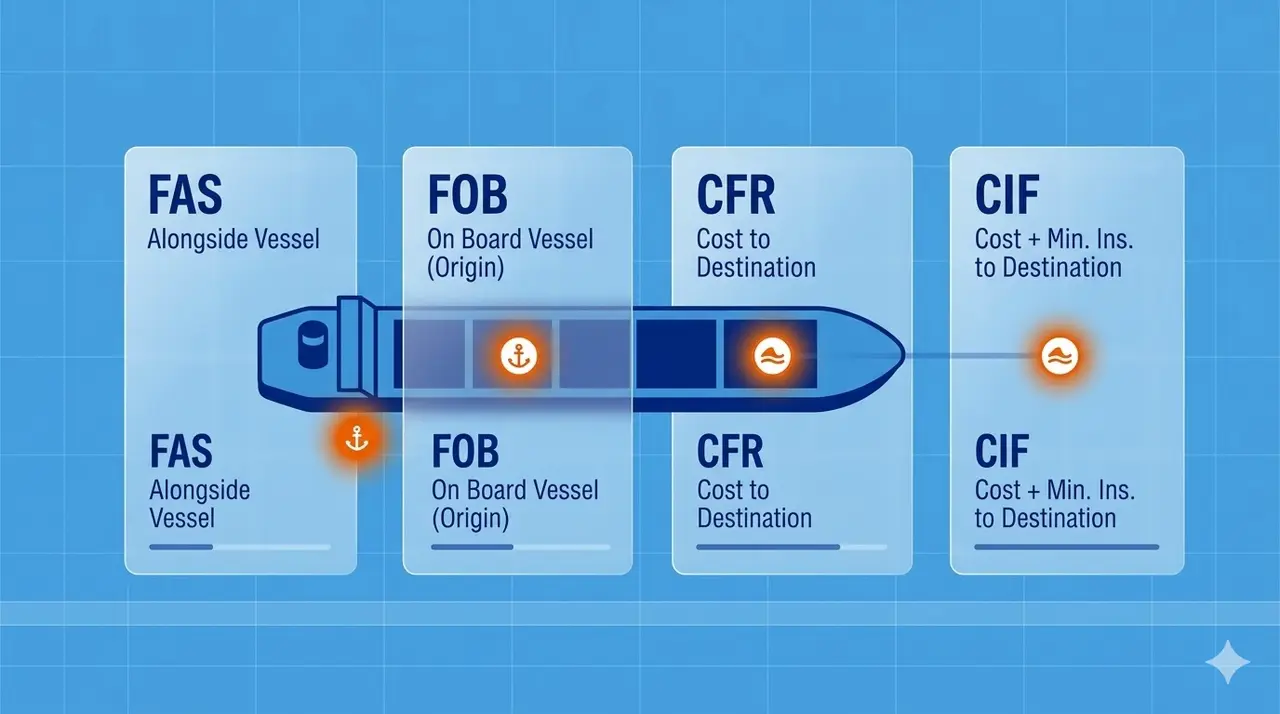
| Incoterm | Responsibility Overview | Risk Transfer Point | Key Characteristics |
| FAS (Free Alongside Ship) | Seller: Clears export and places goods alongside the ship (e.g., on a quay or barge). Buyer: Loads goods onto the ship. |
When goods are placed alongside the vessel. | Non-containerized only. Best for bulk cargo (grains, oil) or heavy machinery requiring direct loading. |
| FOB (Free on Board) | Seller: Loads goods onto the vessel and clears export. Buyer: Arranges main ocean freight. |
When goods are on board the vessel. | The Industry Standard. Seller handles local compliance; buyer controls the freight cost and schedule. |
| CFR (Cost and Freight) | Seller: Pays ocean freight to the destination port. Buyer: Handles insurance and imports. |
When goods are on board the vessel (at origin). | Risk vs. Cost: Seller pays for the journey, but buyer assumes risk as soon as the ship leaves the original port. |
| CIF (Cost, Ins, Freight) | Seller: Pays ocean freight + minimum insurance. Buyer: Handles import. |
When goods are on board the vessel (at origin). | Insurance Caveat: Seller is only required to buy minimum cover (Clause C). Buyers often need supplemental insurance. |
Quick Responsibility Grouping
To simplify selection, Incoterms® are often grouped by the first letter, representing the level of seller responsibility:
- Group E (Departure): EXW. The seller does the minimum. The buyer handles the entire journey.
- Group F (Main Carriage Unpaid): FCA, FAS, FOB. The seller hands over goods to the buyer’s carrier. The buyer pays for the main transport.
- Group C (Main Carriage Paid): CPT, CIP, CFR, CIF. The seller pays for the main transport, but the risk transfers to the buyer at the origin.
- Group D (Arrival): DAP, DPU, DDP. The seller bears all risks and costs to bring the goods to the destination country.
Practical Considerations for 2026
As of 2026, Incoterms® 2020 remains the active global standard. While the rules haven’t changed, the trading environment has evolved. Businesses must consider two emerging factors when selecting a term:
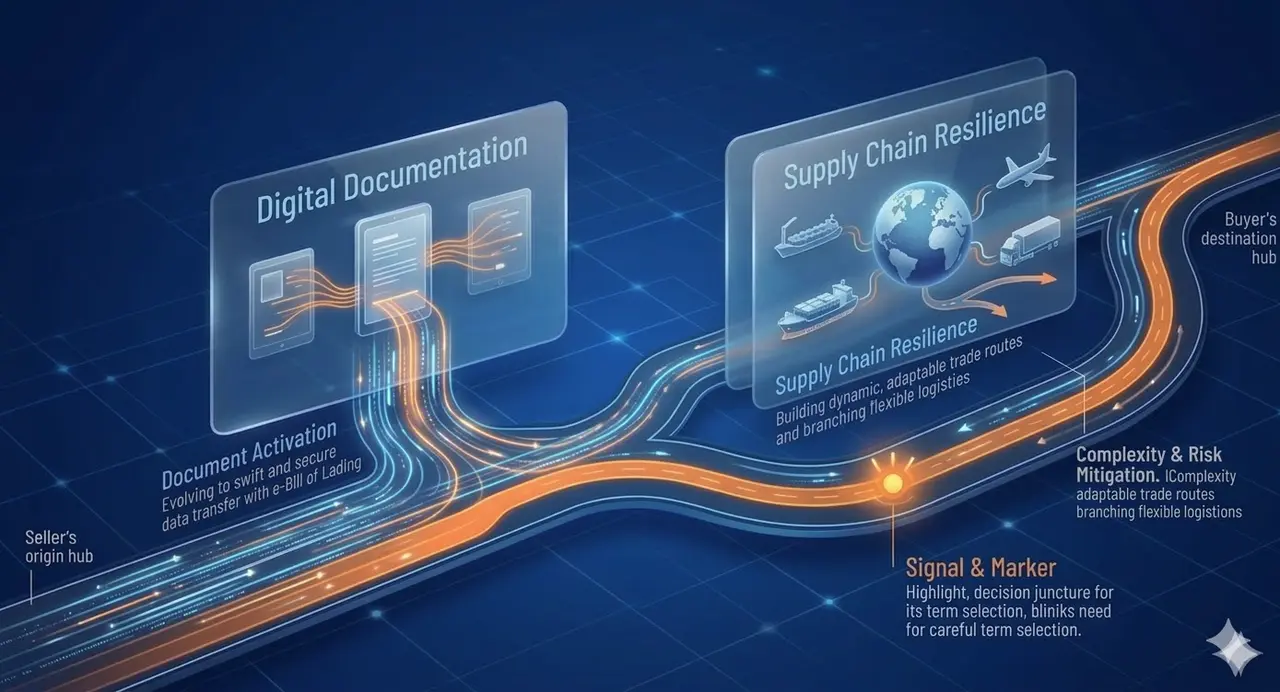
- Digital Documentation: Incoterms® 2020 explicitly supports electronic transport records (e.g., e-Bill of Lading). With the global push for paperless trade, companies should prioritize terms that facilitate digital data transfer over physical courier delivery.
- Supply Chain Resilience: In an era of geopolitical instability (e.g., shipping disruptions in the Red Sea), reliance on EXW is decreasing. Buyers increasingly prefer FCA (Free Carrier) to gain control over export compliance without assuming the risks of inland transport at the origin. Similarly, sellers are wary of DDP due to unpredictable border delays and tax fluctuations.
The 2020 revision of Incoterms introduced several important changes to better reflect contemporary global trade practices and enhance clarity for users.
Critical Compliance Notes
Even though Incoterms® 2020 has been in effect for several years, operational errors persist. Ensure your team adheres to these specific requirements:
- Use DPU, Not DAT: The term DAT (Delivered at Terminal) is obsolete. Use DPU (Delivered at Place Unloaded) for any delivery requiring the seller to unload, whether at a terminal, warehouse, or construction site.
- Verify CIP Insurance: Unlike CIF, which requires minimum cover, CIP now mandates “All Risk” insurance (Institute Cargo Clauses A). Sellers must verify their policies meet this higher standard to avoid breach of contract.
Common Application Errors
Despite clear definitions, misalignment between contractual terms and operational reality causes significant financial loss. Companies frequently encounter the following pitfalls:
Misusing Maritime Terms for Air or Containerized Freight
Companies often default to FOB (Free On Board) for container shipments or air freight. This is legally risky because containers are handed to carriers at a terminal, not at the ship’s rail. If damage occurs at the terminal, liability is ambiguous. The International Chamber of Commerce (ICC) explicitly states in the 2020 rules that FOB is inappropriate for handovers before loading and that FCA (Free Carrier) should be used to close this risk gap.
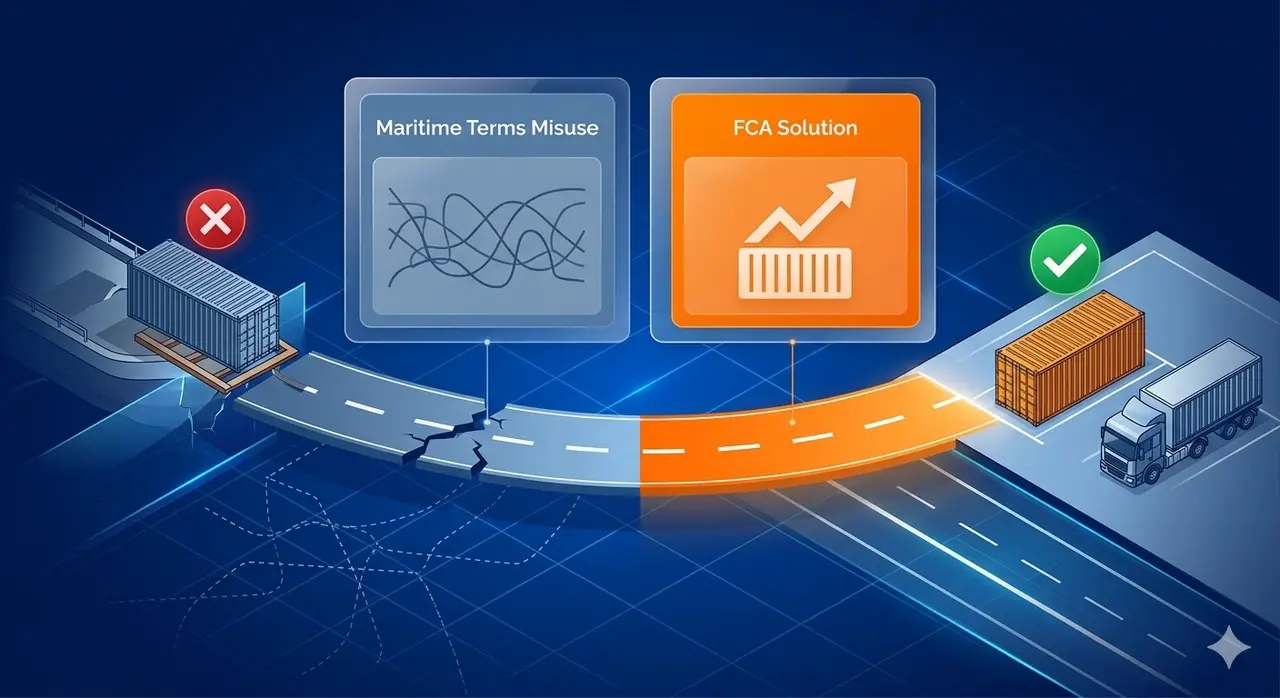
Correction: Use FCA (Free Carrier) for all air and containerized ocean shipments to align risk transfer with the actual handover point at the terminal.
Underestimating DDP Tax Liabilities
Sellers often agree to DDP (Delivered Duty Paid) to win contracts, overlooking the specific role of “Importer of Record.” Under DDP, the foreign seller must pay import duties and VAT. The U.S. International Trade Administration (ITA) warns that foreign sellers may be legally unable to obtain the necessary tax registration to pay for these duties, causing shipments to be abandoned at customs. Furthermore, sellers often cannot reclaim the paid VAT, resulting in a permanent 15-25% loss on the margin.
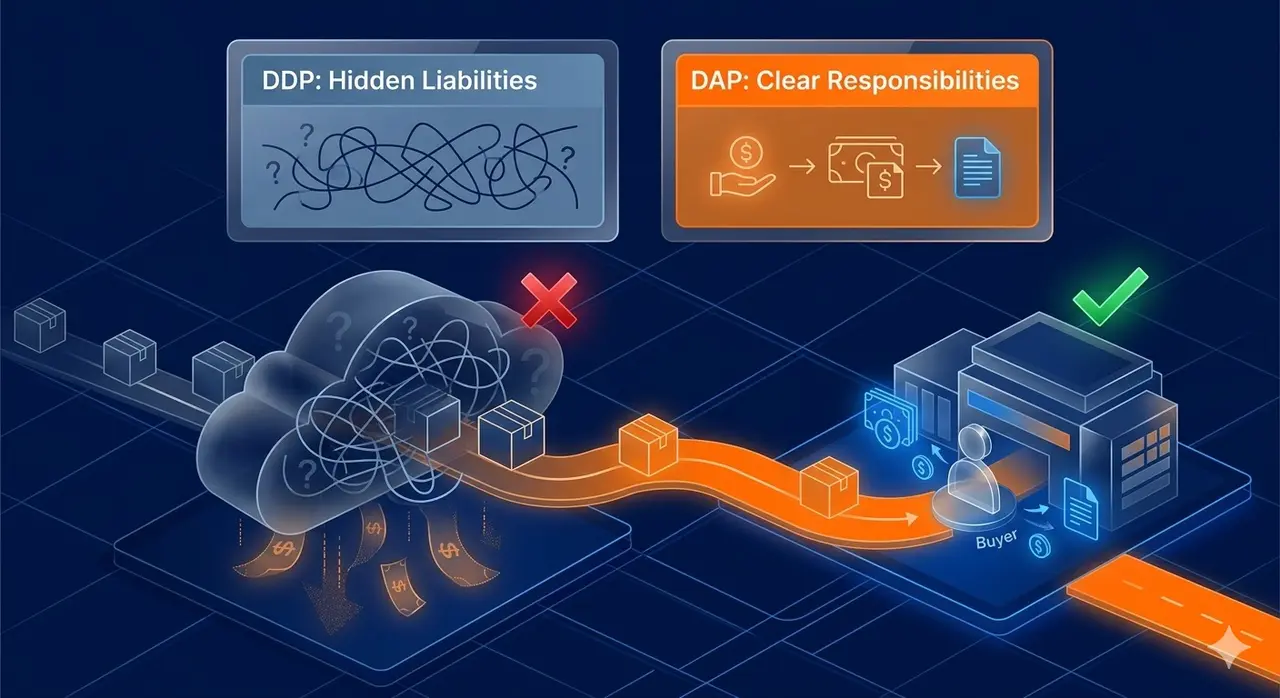
Correction: Use DAP (Delivered at Place) so the buyer handles import formalities and tax payments, which they are often better positioned to reclaim.
The “EXW Loading” Trap
Under EXW (Ex Works), the seller has no contractual obligation to load the goods. However, the ICC Academy highlights a critical operational risk: sellers often load the truck as a practical courtesy, yet the risk remains with the buyer. If the seller’s forklift damages the goods during this process, the buyer is liable for the damage caused by the seller’s own staff. The Academy advises that this liability gap makes EXW unsuitable for most international shipments, as it exposes buyers to risks they cannot supervise.
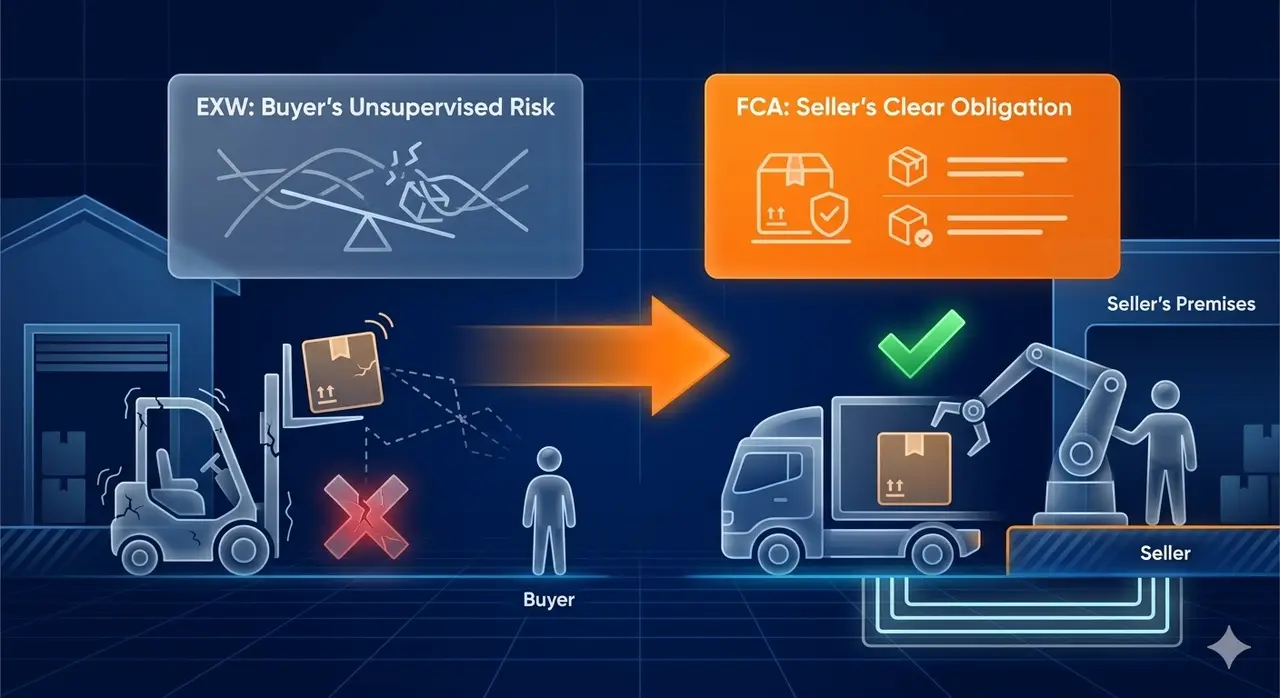
Correction: Use FCA (Seller’s Premises). This term obligates the seller to load the goods and bears the risk during the loading process.
Imprecise Named Places
An Incoterm is legally unenforceable without a precise location. A contract stating “FCA London” is insufficient because London has multiple airports and consolidation warehouses. The ICC Academy emphasizes that failing to specify the exact point (e.g., a specific dock number or warehouse address) prevents the carrier from executing the pickup, leading to failed collection fees.
Correction: Always specify the exact geo-location: “FCA Warehouse B, 123 Logistics Way, London, UK (Incoterms® 2020).”
Decision Checklist: Selecting the Optimal Term
Negotiating the correct Incoterm requires evaluating specific operational capabilities and financial goals. Use this checklist to guide the decision:
Cargo Configuration (FOB vs. FCA): Is the cargo containerized or bulk?
For containerized goods, the International Chamber of Commerce (ICC) advises against using FOB or CIF. Since containers are delivered to a terminal (CY) rather than the ship’s rail, the risk transfer point under FOB is operationally flawed. Use FCA or CIP to align the risk transfer with the actual handover in the container yard.
Import Compliance (DDP vs. DAP): Can the seller legally handle customs at the destination?
DDP requires the seller to act as the “Importer of Record.” The U.S. International Trade Administration warns that foreign sellers often lack the legal registration required to pay VAT or GST in the buyer’s country, leading to shipments being impounded. Unless the seller has a registered local entity, DAP is the safer, compliant choice.
Conclusion
Incoterms® are more than shipping acronyms; they are critical tools for financial and operational risk management. Effective negotiation requires moving beyond the default choice. By aligning the Incoterm with the specific mode of transport, payment terms, and risk appetite, companies secure their supply chains against the volatility of modern global trade. Always reference “Incoterms® 2020” in contracts to ensure legal clarity.