

In the competitive landscape of B2B procurement, controlling external spend is a critical driver of profitability. Research by Bain & Company indicates that for many organizations, purchasing costs can account for up to 50% of total revenue, making efficient sourcing strategies vital for financial health. The Request for Quotation (RFQ) serves as the primary instrument for optimizing these costs, specifically for standardized goods and services.
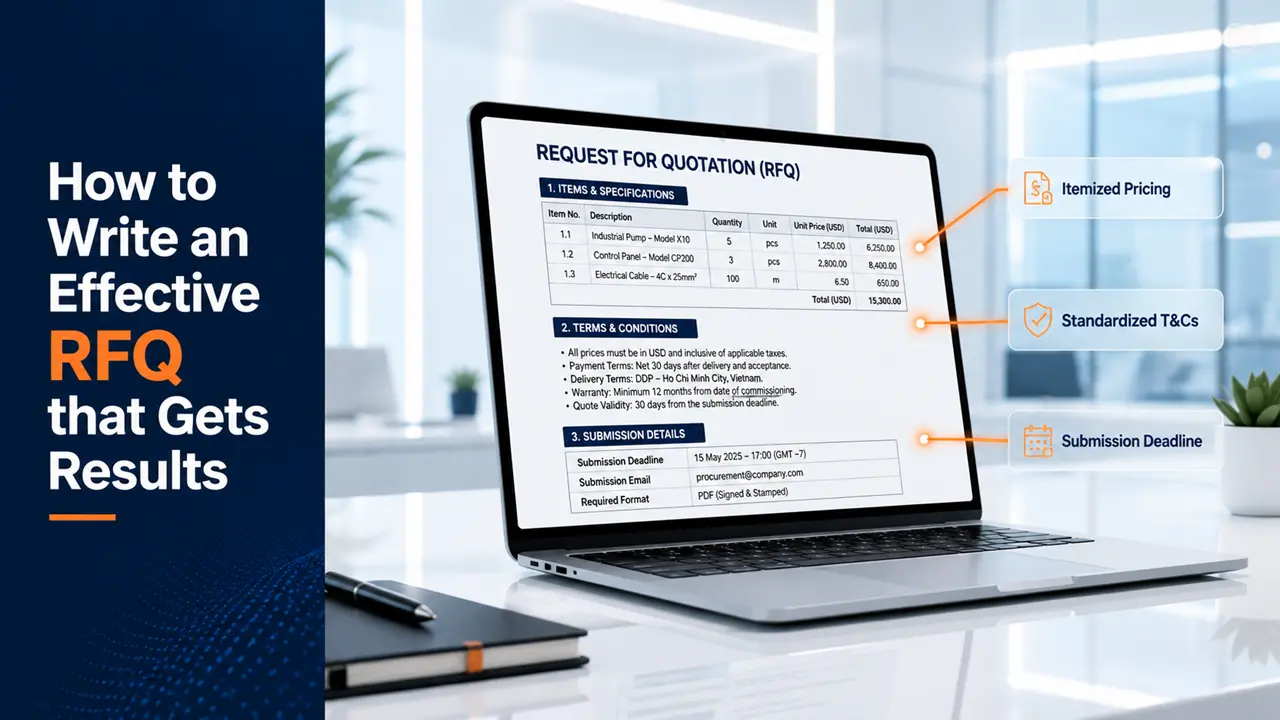
Unlike complex solicitations that seek problem-solving methodologies, the RFQ focuses strictly on commercial terms for clearly defined requirements. This clarity allows buyers to conduct a direct, line-by-line comparison of vendor bids, ensuring the organization secures the best market value. This guide examines the strategic deployment of RFQs, detailing the end-to-end process from document preparation to final supplier selection to drive tangible cost savings.
Contents
Understanding the Request for Quotation (RFQ)
A Request for Quotation (RFQ) invites suppliers to submit specific price bids for products or services with standardized requirements. Organizations use this document when the specifications are known and unchangeable, making price and delivery terms the primary comparison factors. According to the Chartered Institute of Procurement & Supply (CIPS), an RFQ effectively secures the best commercial terms for low-complexity or high-volume items where technical capabilities are not the main differentiator.
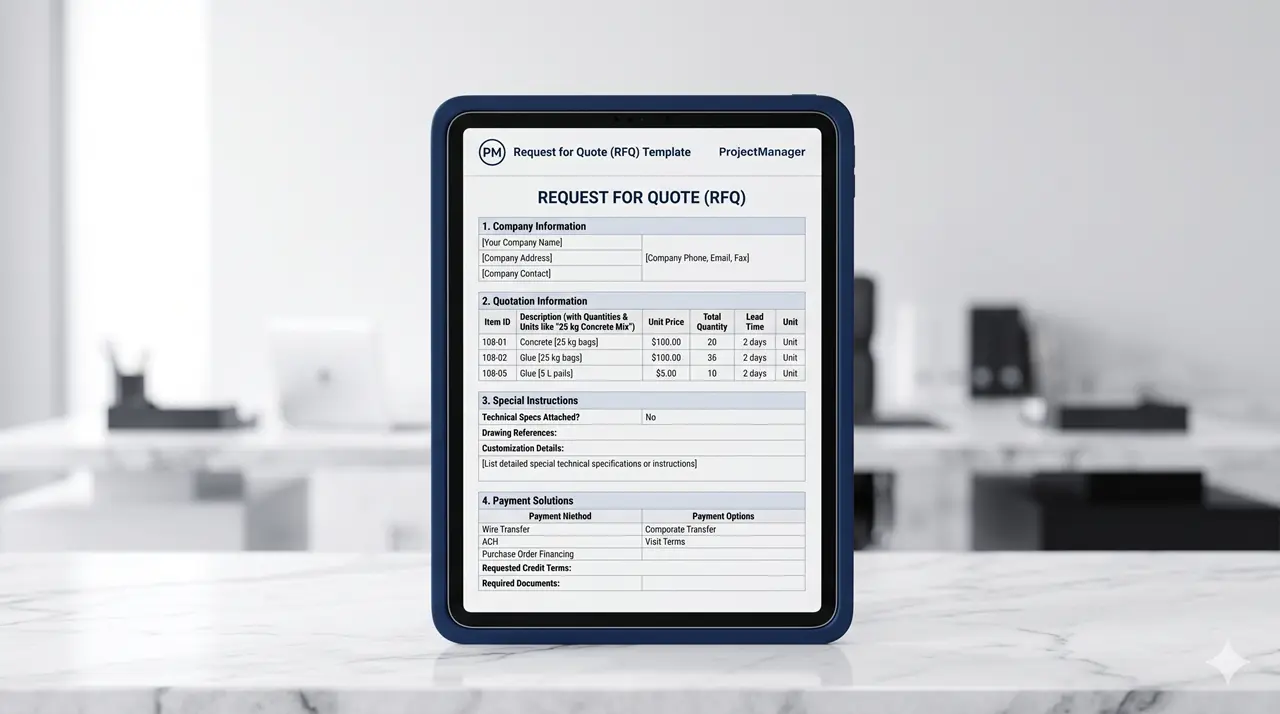
Buyers must distinguish the RFQ from a legal contract. An RFQ solicits an offer, but a binding agreement forms only after the buyer issues a formal Purchase Order (PO) and the vendor accepts it. In project management workflows, teams use RFQs to standardize vendor responses. This standardization allows procurement managers to conduct a direct, line-by-line comparison of costs, ensuring the project secures necessary materials within the approved budget without administrative ambiguity.
When to Use an RFQ?
Procurement teams utilize the RFQ process when requirements are rigid, standardized, and focused primarily on cost. Unlike the Request for Proposal (RFP), which seeks solution-based responses, the RFQ targets clearly defined deliverables. According to the Chartered Institute of Procurement & Supply (CIPS), organizations should deploy an RFQ under the following specific conditions:
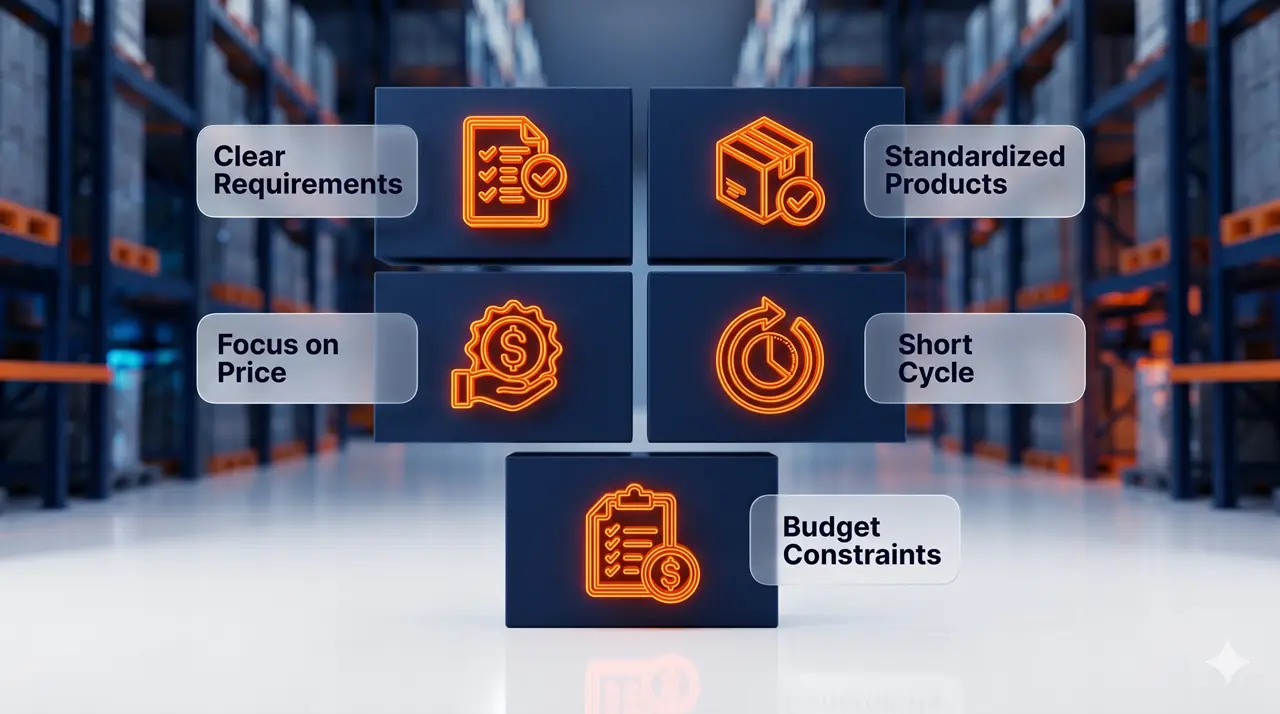
- Commoditized Goods: The requirement involves standard, off-the-shelf products with no need for customization (e.g., office supplies, IT hardware, or raw materials). The specifications are granular and non-negotiable.
- Pre-qualified Vendor Lists: Buyers often restrict RFQs to a pool of known, vetted suppliers. This approach mitigates operational risk since the focus is on price negotiation rather than validating vendor capability.
- High-Volume, Recurring Orders: The process suits bulk procurement where economies of scale apply. Since technical specifications are fixed, buyers use the RFQ to secure the lowest unit price for repetitive orders.
- Price as the Sole Differentiator: When quality and delivery terms are standardized across the market, price becomes the deciding factor. If the project requires complex value-added services or innovative problem-solving, industry standards suggest shifting to an RFP instead.
Core Benefits of a Well-Written RFQ
A precise and structured RFQ document serves as a critical control mechanism in procurement. By eliminating ambiguity upfront, organizations standardize vendor responses, enabling a direct comparison of value. Industry data indicates that well-defined sourcing processes lead to the following strategic advantages:
- Cost Optimization through Competition: Clear specifications allow buyers to conduct an “apples-to-apples” comparison of bids. This transparency creates a competitive environment among pre-qualified suppliers. According to the Chartered Institute of Procurement & Supply (CIPS), competitive bidding processes driven by clear documentation effectively identify the true market price and prevent overcharging.
- Reduced Cycle Time: Standardized templates and mandatory response formats minimize the need for clarification emails and follow-up meetings. Ardent Partners reports that best-in-class procurement teams—those utilizing standardized sourcing tools—can reduce requisition-to-order cycles by up to 50% compared to average performers.
- Risk Mitigation: According to the Project Management Institute (PMI), detailed technical requirements significantly reduce the probability of vendor error and scope creep. By ensuring specifications are explicit, organizations legally bind suppliers to precise deliverables, thereby protecting the project from delays caused by misinterpretation.
Strategic Procurement Documents: RFQ vs. RFP vs. RFI
Procurement departments utilize three primary documents to engage vendors depending on the project stage and requirement clarity. Selecting the correct format is essential for receiving relevant responses and optimizing the sourcing cycle. According to the CPIS, the distinction lies in whether the buyer is seeking information, a solution, or a price.
| Feature | Request for Information (RFI) | Request for Proposal (RFP) | Request for Quotation (RFQ) |
| Primary Goal | Market Research: Gather general information and explore vendor capabilities. | Solution Seeking: Solicit detailed methodologies, creative approaches, and technical solutions. | Price Comparison: Secure the best price for standardized goods with non-negotiable specs. |
| Procurement Stage | Initial Phase: Problem is defined, but potential solutions or suppliers are unknown. | Evaluation Phase: Problem is defined; specific expertise is needed to design the solution. | Closing Phase: Specifications are fixed; the decision relies solely on commercial terms. |
| Key focus | Broad capabilities and market availability. | Holistic value (Methodology + Experience + Cultural Fit + Price). | Price, delivery timelines, and payment terms. |
| Question Style | Open-ended questions to “test the waters.” | Specific questions regarding strategy, implementation, and quality. | Structured, quantitative fields for unit costs and discounts. |
| Vendor Response | General company information and high-level approaches. | Detailed proposals, project roadmaps, and technical diagrams. | Precise financial bids and confirmation of delivery dates. |
Summary based on CIPS standards:
- Use RFI to educate yourself.
- Use RFP to find a partner for complex needs.
- Use RFQ to buy commodities at the lowest cost.
The End-to-End RFQ Process
A standardized RFQ process ensures transparency and operational efficiency. Modern procurement teams leverage e-sourcing platforms (SaaS) to automate these workflows. According to Deloitte’s Global CPO Survey, high-performing procurement organizations are 4-5 times more likely to use advanced analytics and digital tools to manage vendor interactions and reduce administrative overhead.
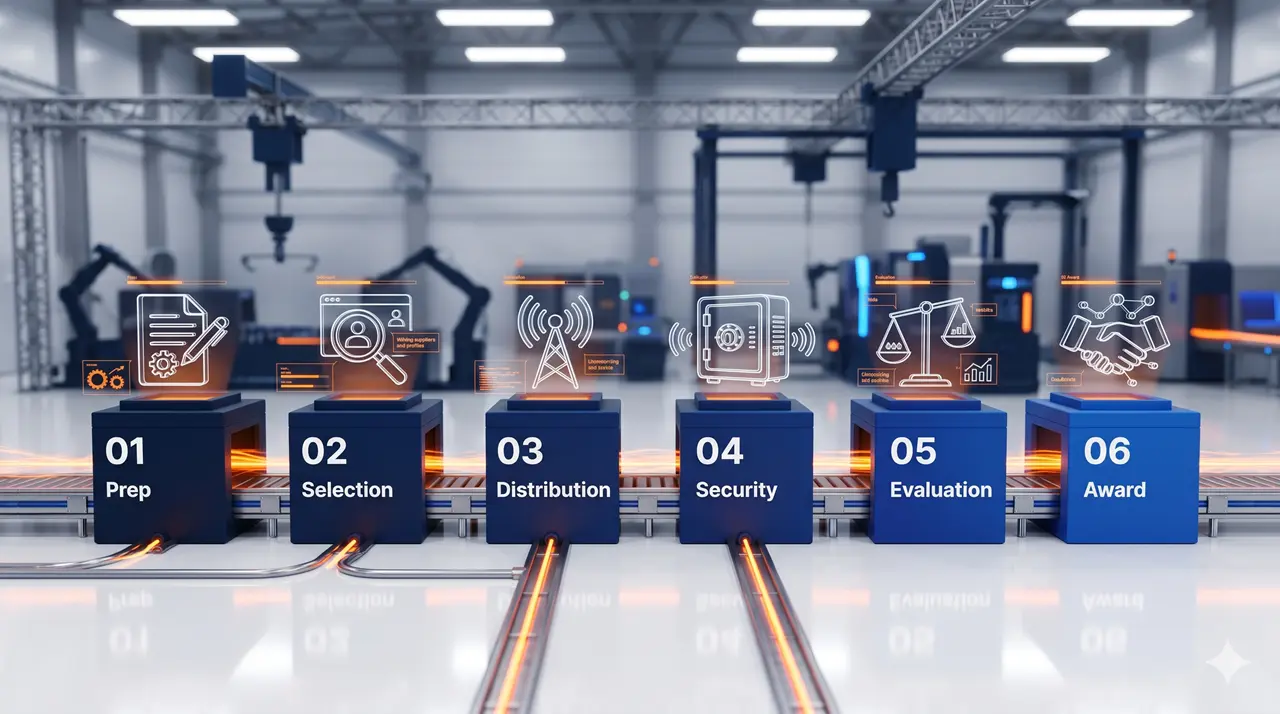
Step 1: Document Preparation
This phase defines the project parameters to ensure comparable bids. Key actions include:
- Define Scope & Budget: Collaborate with stakeholders to finalize technical specifications and quantity requirements. Establishing a clear budget range filters out unrealistic bids early in the process.
- Standardize Templates: Use a fixed response format. This forces suppliers to submit data uniformly, facilitating a direct line-by-line comparison later.
- Assign Point of Contact: Designate a single communication channel to manage vendor inquiries, preventing conflicting information.
Step 2: Supplier Identification & Selection
Buyers must identify a pool of capable vendors to balance competition with manageability.
- Risk Assessment: Before inviting a vendor, conduct due diligence on their financial stability and operational capacity.
- Optimal Bidder Number: Procurement best practices suggest soliciting between three to eight bids. The CPIS notes that inviting fewer than three suppliers limits competition, while inviting too many creates administrative bottlenecks with diminishing returns on price reduction.
Step 3: Distribution & Communication
The distribution phase must guarantee equal treatment for all participants to maintain ethical standards.
- Clear Instructions & Deadlines: Provide unambiguous submission guidelines and a firm closing date.
- Terms & Conditions: Attach standard legal terms (T&Cs) upfront, so vendors account for contractual obligations in their pricing.
- Transparent Q&A: Implement a formal clarification process. According to NIGP (The National Institute of Governmental Purchasing), if one supplier asks a question, the buyer must share both the question and the answer with all other bidders to ensure a “level playing field”.
Step 4: Response Handling & Security
To maintain process integrity, the buying organization must strictly enforce submission deadlines. Best practices dictate a “Sealed Bid” protocol, where all proposals are opened simultaneously after the deadline passes.
- Confidentiality: Utilizing e-procurement software ensures that bids remain encrypted and inaccessible until the official opening time. This prevents internal bias and protects vendor pricing data.
- Tracking: Procurement teams must log every receipt to establish an audit trail. The NIGP emphasizes that a transparent, documented opening process is the primary defense against bid-rigging allegations.
Step 5: Evaluation & Selection
The evaluation committee scores submissions against the criteria defined in Step 1 (Technical Compliance + Price).
- Selection Logic: In an RFQ, the award typically goes to the “Lowest Responsive and Responsible Bidder” – the vendor offering the lowest price who also meets all technical specifications and delivery requirements.
- Documentation: Every decision metric must be recorded. According to CIPS, maintaining a robust paper trail of the evaluation methodology is not just for internal policy; it is essential for defending the decision during external audits or vendor disputes.
Step 6: Award & Supplier Debriefing
The process concludes with contract execution and communication.
- Contract Finalization: Buyers convert the winning bid into a binding contract or Purchase Order (PO). Since terms were attached to the original RFQ, negotiation at this stage should be minimal.
- Relationship Management: Once the contract is signed, the buyer must notify unsuccessful bidders promptly. Providing feedback (debriefing) is a strategic component of Supplier Relationship Management (SRM). Research from Harvard Business Review suggests that transparent communication with rejected vendors maintains market goodwill, ensuring they remain willing to bid competitively on future projects.
How to Write a High-Impact RFQ
An effective RFQ serves as a rigid framework that standardizes supplier responses. By providing explicit instructions and data requirements, buyers minimize the clarification cycle and ensure accurate pricing. According to the CPIS, a robust specification document is the single most critical factor in achieving “Value for Money” and preventing contract disputes.
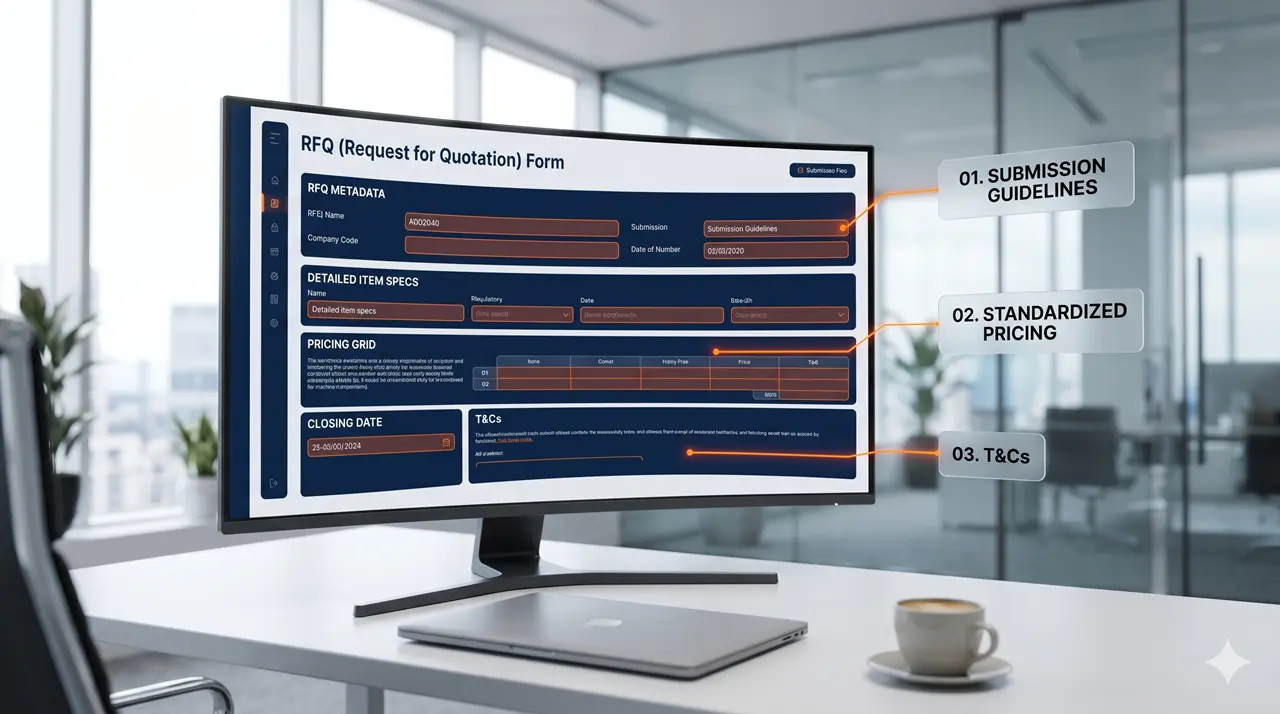
Key Components of an RFQ Document
A comprehensive RFQ document must be structured logically to provide all necessary information. Key components include:
- Submission Guidelines: Clearly state the submission deadline (date/time) and the mandatory delivery format (e.g., e-sourcing portal or encrypted email). Strict adherence to these rules ensures process integrity.
- Executive Summary & Scope: Outline the project background, business objectives, and constraints. This context helps vendors qualify themselves (Go/No-Go decision) before investing time in a detailed response.
- Detailed Specifications: Provide granular technical requirements, including part numbers, quantities, material grades, and delivery schedules. Ambiguity here directly correlates to pricing variances.
- Standardized Pricing Template: Require vendors to input costs into a fixed table (Itemized Cost Breakdown). This structure prevents hidden fees and facilitates a direct, line-by-line comparison of quotes.
- Commercial Terms & Conditions (T&Cs): Attach the organization’s standard contract terms regarding payment cycles (e.g., Net 30), warranties, and penalties for non-compliance. Establishing these upfronts avoids protracted legal negotiations later.
- Selection Criteria: Transparency is key. Define how the winning bid will be chosen (e.g., 70% Price, 30% Delivery Speed). The National Institute of Governmental Purchasing (NIGP) advises that publishing evaluation criteria mitigates the risk of bid protests and ensures suppliers focus on the factors that matter most to the buyer.
- Vendor Prequalification Requirements: List mandatory certifications (e.g., ISO 9001), licenses, or insurance coverage required to be eligible for the contract.
Optimizing the RFQ Outreach Email
Email remains the primary channel for initiating vendor contact. To maximize response rates and ensure clarity, communication must be concise, actionable, and structured for quick scanning. HubSpot’s sales communication research indicates that emails with clear subject lines and bulleted content significantly outperform dense text blocks in B2B interactions.

Best Practices for RFQ Emails:
- Subject Line: Must be specific. Use the format: [RFQ] – [Project Name/Item Name] – [Company Name]. This ensures immediate recognition and easier email retrieval later.
- Opening: Briefly introduce the sender’s role and the organization. State the intent immediately (e.g., “We are sourcing suppliers for X”).
- Body Content: Avoid paragraphs. Use bullet points to list specific items, quantities, and delivery locations.
- Call to Action (CTA): Clearly state the submission deadline (Date & Time) and the preferred format (PDF, Excel, Portal Link).
Sample Structure:
Subject: RFQ: Supply of [Product Name] – [Company Name] – Deadline: [Date]
Dear [Vendor Name/Sales Team],
I am [Your Name], Procurement Manager at [Company Name]. We invite your company to submit a quote for the supply of [Product Name] based on the attached specifications.
Requirements Overview:
- Item: [Name/Model Number]
- Quantity: [Number of Units]
- Delivery Location: [City, Country]
- Required Delivery Date: [Date]
Please review the attached RFQ document for detailed technical specifications and terms.
Submission Deadline: [Date] at [Time]
Kindly confirm receipt of this email.
Regards,
[Signature]
Strategic Bid Structures
Selecting the appropriate bid structure directly impacts competitive intensity and compliance. Procurement managers must weigh transparency against the risk of collusion based on the project nature. According to the National Institute of Governmental Purchasing (NIGP) and CIPS, the four primary bid types serve distinct strategic functions:
| Structure Type | Definition | Best Used For | Strategic Advantage | Potential Risk |
| Open Bid (Public Tender) | Bids are visible to all participants during the process. | Projects requiring maximum exposure; less sensitive items. | Drives aggressive pricing through high visibility. | High risk of collusion or price signaling among vendors. |
| Sealed Bid | Bids remain confidential/encrypted until a fixed deadline. | Public sector projects; high-compliance requirements. | Ensures fairness; prevents bias; secures “Best & Final Offer” upfront. | Lacks dynamic feedback; suppliers cannot adjust prices based on competition. |
| Invited Bid (Selective) | Only pre-vetted, trusted suppliers are invited to quote. | Recurring purchases; urgent timelines; strategic partnerships. | Speed & Efficiency; low administrative burden; trusted quality. | Limits market discovery; may result in higher costs due to lack of competition. |
| Reverse Auction (e-Auction) | Sellers compete in real-time to offer the lowest price. | Commoditized goods; bulk raw materials; standardized services. | Delivers rapid cost reduction (avg. 10-20% savings) | Can damage supplier relationships; risks quality shortcuts to meet price. |
Summary based on NIGP & CIPS standards:
- Use Sealed Bids for fairness and compliance.
- Use Invited Bids for speed and trusted partners.
- Use Reverse Auctions for aggressive cost cutting on commodities.
Phase 1: Supplier Research & Vetting (Due Diligence)
Prior to sending an RFQ, procurement teams must qualify potential vendors to mitigate operational risk. This “Due Diligence” phase validates that a supplier is legitimate and capable. According to ThomasNet and CIPS, a robust vetting process includes three layers of verification:
- Financial Health: Analyze credit reports (e.g., Dun & Bradstreet) to ensure the supplier has financial stability to fulfill long-term contracts without bankruptcy risk.
- Operational Capability: Verify production capacity and technological fit. For critical components, an on-site audit is recommended to assess quality control systems directly.
- Compliance & Certifications: Validate essential credentials such as ISO 9001 (Quality Management) or ISO 14001 (Environmental Management). Checking business licenses and litigation history prevents future legal liabilities.
Phase 2: Response Evaluation (The Weighted Scoring Method)
Objectivity is paramount when selecting a winner. Procurement best practices recommend using a Weighted Decision Matrix to quantify qualitative factors. This approach prevents the “lowest price trap” by assigning value to non-cost attributes.
Example Evaluation Model:
- Price (Total Cost of Ownership): 40%
- Quality Assurance (QA) Processes: 30%
- Delivery Lead Time: 20%
- Financial Stability: 10%
By scoring each vendor against these pre-defined weights, the evaluation committee derives a factual, data-driven ranking. McKinsey & Company emphasizes that separating “Price” from “Technical” scores during the initial review helps maintain unbiased judgment.
Negotiation & Contracting: The final selection triggers the contracting phase. Here, the focus shifts from price to Service Level Agreements (SLAs) and Key Performance Indicators (KPIs), laying the groundwork for a strategic, long-term partnership rather than a transactional purchase.
Advanced Strategies for RFQ Management
Optimizing the RFQ process requires moving beyond administrative compliance to strategic value creation. According to CIPS and Deloitte, leading procurement organizations adhere to the following operational standards to maximize outcome quality.
Best Practices for RFQ Success
- Granularity is Key: Specificity reduces risk. Provide detailed technical drawings, Bill of Materials (BOM), and service expectations. Ambiguity forces suppliers to buffer their prices to cover unknown risks.
- Realistic Timelines: Quality responses require time. Best practices suggest a minimum of 10 business days for standard commodities and 4-6 weeks for complex engineered parts. Rushing vendors often leads to calculation errors or “no-bid” decisions.
- Formal Q&A Protocol: Establish a structured clarification period. Sharing all Q&A publicly ensures fairness and often highlights gaps in the original specification that the buyer may have missed.
Strategic Pitfalls: The TCO Trap
The most significant error in RFQ management is “Price Myopia” – focusing solely on the upfront purchase price. This approach ignores the Total Cost of Ownership (TCO), which includes maintenance, logistics, quality failure costs, and payment terms.
- Risk: A low-cost supplier with a high defect rate will cost more in the long run due to production stoppages.
- Solution: Incorporate TCO metrics into the evaluation criteria from Day 1.
Vendor Perspective: What Defines a Quality Response?
From a supplier’s viewpoint, a professional RFQ signals a serious buyer. Top-tier vendors prioritize RFQs that are organized and funded. In return, buyers should expect:
- Compliance: Full adherence to the submission format.
- Value Engineering: Proactive suggestions where a slight specification change could reduce cost or improve lead time.
- References: Verifiable case studies from similar clients rather than generic marketing claims.
Related Procurement Instruments
Understanding the broader toolkit ensures the right document is used for the right purpose:
- RFP (Request for Proposal): For seeking solutions to complex problems, not just prices.
- RFI (Request for Information): For market research and vendor pre-qualification.
- SOW (Statement of Work): A narrative document defining specific project activities and deliverables, often attached to the RFQ.
- ITB (Invitation to Bid): Common in construction/government; a rigid request focused strictly on pricing against a locked specification.
Conclusion
Mastering the Request for Quotation (RFQ) process transitions procurement from a tactical administrative function to a strategic value generator. While the primary objective of an RFQ is cost optimization, successful execution requires balancing competitive pricing with quality assurance and supply reliability. By adhering to structured workflows and leveraging data-driven evaluation matrices (such as Total Cost of Ownership), organizations effectively mitigate operational risks while securing the lowest possible price.
Furthermore, the shift toward digitalization is reshaping how RFQs are managed. According to Gartner, procurement teams that fully digitize their sourcing processes, including RFQ management, can expect a 15-20% reduction in cycle times and significant improvements in compliance. Ultimately, a well-managed RFQ process does not just save money; it establishes a transparent, fair foundation for sustainable long-term supplier partnerships.
