 English
The Role of AI in Modern Businesses
May 7, 2025
Popular AIs have some “fatal flaws” that make them unsuitable for immediate application in businesses. Enterprises need a different approach.
Artificial Intelligence (AI) is one of the hottest topics in the media today. It’s widely praised for its outstanding features and high applicability in work environments. The adoption of AI is even considered a “matter of survival” for businesses in the near future. However, AI expert Mr. Nguyễn Hồng Phúc argues that many enterprises lack scientific understanding and practical experience, leading to misunderstandings and ineffective AI applications.
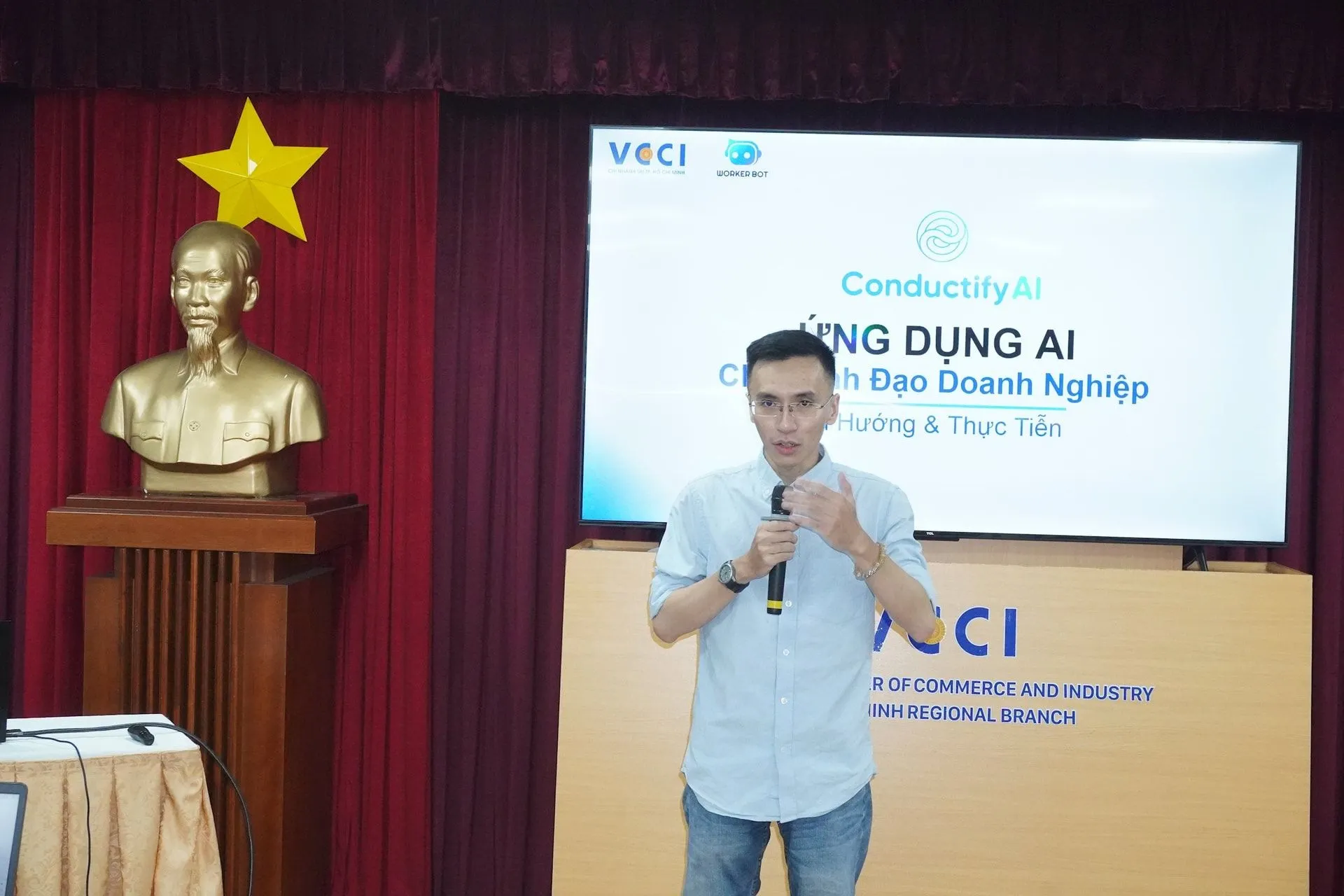
Mr. Nguyễn Hồng Phúc: AI has weaknesses that cannot be immediately applied to businesses
“Fatal Flaws” of Popular AI
Speaking at the training course “Leaders Understanding Artificial Intelligence, Businesses Grasping the Future” organized by VCCI Ho Chi Minh City on March 6, 2025, Mr. Phúc emphasized that general-purpose AIs on the market today have fatal flaws that make them unsuitable for immediate deployment in enterprise operations.
First is accuracy. According to Mr. Phúc, the algorithms used in popular AIs like ChatGPT are probability-based. As a result, their accuracy is not high - current average accuracy is about 60%.
“That means out of 10 responses, about 6 will be correct and 4 wrong. This is unacceptable in a business environment,” Mr. Phúc explained.
Second, AI only possesses the ability to “know,” not the ability to truly “understand.” When given a task, AI performs it in a mechanically correct order, without understanding the context or meaning behind it - leading to inflexible results that often fall short of expectations.
Third, a very serious issue is data security. Each time AI is used, users essentially provide their private data to the companies that run the AI systems. This poses major risks - and is one of the key reasons why many major corporations have banned the use of general-purpose AI tools.
In addition, AI still faces unresolved debates in both scientific and legal domains. For example, ethical questions remain: Can AI be allowed to swear? Can it help humans commit unethical or illegal acts?
Because of these issues, Mr. Phúc concludes that popular AI tools - whether free or low-cost - should be reserved for personal experimentation only, and not be used in business operations.
Enter the “AI Employee”
So, how should businesses adopt AI?
Mr. Phúc introduced a rapidly emerging global concept known as the AI Agent.
While there is no standardized Vietnamese term for this, as an AI scientist, Mr. Phúc proposed calling them “AI Employees” due to their role in business being functionally similar to that of human staff.
This is a different approach to AI - one built specifically for professional work environments.
According to Mr. Phúc, an “AI Employee” possesses eight capabilities:
- Operates like a robot running on a computer;
- Can use existing software on that computer;
- Can learn workflows and perform tasks automatically;
- Can learn about the enterprise through its internal data;
- Can analyze data and deliver accurate answers;
- Has lower operational cost than a human in the same role;
- Works faster and more efficiently than human staff;
- Operates on in-house computers and servers, ensuring data security.
Currently, these “AI Employees” are being deployed in three main business functions:
- Sales support
- Customer service
- Internal operations
These AI systems communicate using natural language via familiar chat apps. Employees simply ask questions or give commands in natural language, and the AI directly interacts with the enterprise’s business software to complete the task and return instant results.
Mr. Phúc stated that these “internal AI Employees” are the main reason behind recent mass layoffs - affecting tens of thousands of employees at major global corporations. These AI Employees are replacing humans in equivalent roles and delivering better performance.
In Vietnam, for example, Mr. Phúc shared that a diamond ring company, after implementing AI Employees, was able to reduce its design team from 8 people to just 1, while increasing speed by many times.
“This is an irreversible trend,” Mr. Phúc warned. Enterprises that don’t want to be left behind must quickly study and adopt AI systematically, with serious investment.
By Quân Bảo / Diễn Đàn Doanh Nghiệp
Read the original article here.
Technology


.png?width=1920&quality=90)