
 English
How Is AI Transforming B2B E-commerce?
B2B e-commerce is entering a new phase of growth as more businesses shift their partner discovery, market expansion, and transaction activities to digital environments.
According to Statista, the global B2B e-commerce market is projected to exceed $20 trillion by 2027—significantly larger than the B2C market.
However, as the number of businesses and products on digital platforms continues to grow rapidly, a new challenge has emerged: the massive and increasingly complex volume of trade data.
A single B2B platform may need to process millions of company profiles, tens of millions of products, and purchasing demands from multiple countries.
In this context, artificial intelligence (AI) is becoming a critical tool for organizing data and enabling more efficient business matching.

1. AI Enables Structured and Standardized Data
One of the biggest challenges in B2B e-commerce is unstructured data.
For example:
- Company profiles are presented in various formats
- Products are described in multiple languages
- Technical standards are inconsistent
This makes it difficult for buyers to search for and compare suppliers effectively.
AI addresses this issue by:
- Analyzing company profile content
- Identifying business sectors
- Classifying product categories
- Standardizing data into a unified structure
With well-organized data, B2B platforms can build more accurate search and matching systems.
2. AI Accelerates Partner Discovery
In international trade, finding the right partner is often time-consuming. Businesses must search for suppliers, verify capabilities, and compare multiple options.
Modern B2B platforms are increasingly leveraging recommendation algorithms to streamline this process. For instance, Alibaba analyzes search behavior and transaction history to suggest relevant suppliers, while Global Sources uses industry data to connect buyers with manufacturers.
With AI, systems can evaluate compatibility between buyers and suppliers based on:
- Industry
- Product
- Production capacity
- Market demand
This significantly reduces the time required to identify suitable partners.
3. AI Helps Identify Market Trends
Beyond matchmaking, AI also enables advanced market intelligence.
By processing data such as search behavior, product trends, and transaction activity, AI can help businesses:
- Identify high-growth industries
- Detect potential markets
- Adjust product strategies
For example, Amazon Business uses machine learning to analyze purchasing behavior and recommend relevant products to business buyers.
4. From “Listing Platforms” to “Intelligent Trade Matching Systems”
Traditionally, many B2B platforms functioned as listing platforms, where businesses uploaded profiles and waited for potential partners to reach out.
However, as the number of companies on these platforms has grown rapidly, this model has revealed its limitations:
- Difficulty in finding the right partners
- Fragmented data
- Missed business opportunities
AI is driving a shift toward a new model: data-driven trade platforms.
In this model:
- Business data is standardized
- Market demand is continuously analyzed
- Platforms proactively recommend trade connections
5. Arobid and AI-Driven Digital Trade Infrastructure
In line with this trend, some platforms are evolving toward AI-driven digital trade infrastructure.
Arobid V2.0 is one such platform, designed to integrate AI across the entire trade facilitation process.
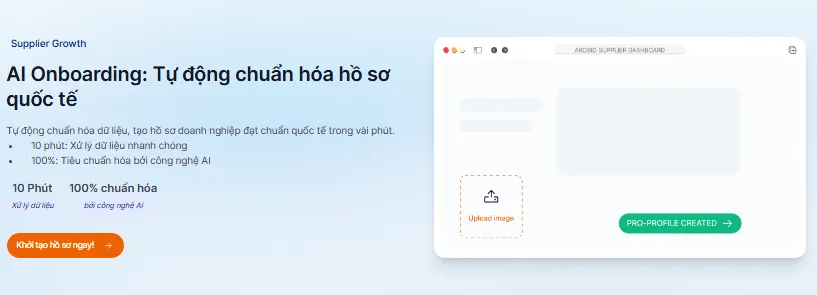
AI Onboarding – Standardizing Business Profiles
When businesses join the platform, the AI Onboarding system analyzes and standardizes their profiles.
By simply inputting a company website, AI can automatically extract and process data, identify business sectors, and restructure information into a unified format. This process can be completed within minutes.
As a result, onboarding becomes faster and simpler, while ensuring consistent data across the platform.
AI Deep Search – Intelligent Business and Product Discovery
With standardized data in place, the platform deploys an AI-powered Deep Search Engine.
This system enables buyers to search for suppliers, products, and services across supply chains and virtual exhibitions using multiple layers of data, including: Industry, Technical standards, Production capabilities, Export markets
Rather than relying solely on simple keywords, AI analyzes context and relationships between data points, delivering more accurate and relevant results.
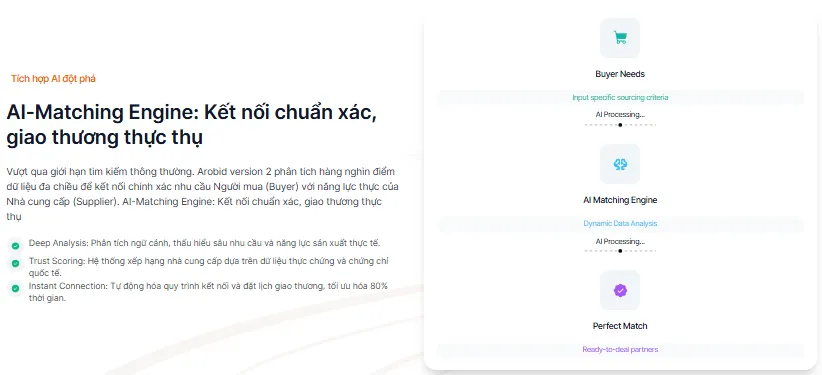
AI Buyer Find & Match – Precision Trade Matching
Another key feature is AI Buyer Find & Match.
The system analyzes:
- Industry data
- Purchasing demand
- Buyer intent signals
Based on these inputs, it automatically recommends the most suitable buyers and suppliers within the supply chain, prioritizing connections with high transaction potential.
This allows businesses not only to showcase their profiles but also to be proactively matched with relevant partners.
AI Is Shaping the Future of B2B E-commerce
As the volume of business and market data continues to grow, AI is becoming a foundational technology for B2B e-commerce platforms.
Platforms that combine data, algorithms, and digital trade infrastructure will play an increasingly important role in helping businesses:
- Find partners
- Expand into new markets
- Identify trade opportunities
In this context, AI-powered trade systems are expected to become the core infrastructure connecting global businesses in the digital economy.
Explore Arobid Digital Trade Platform
Arobid is developing Arobid V2.0—a digital infrastructure for trade and investment promotion, integrating global B2B e-commerce and powered by AI under the strategy of AI-Driven Digital Trade Infrastructure. The ecosystem supports businesses in:
- Standardizing company profiles with AI Onboarding
- Searching business data via AI Deep Search Engine
- Connecting with partners through AI Buyer Find & Match
>>> Learn more at: arobid.com
Technology



.png?width=1920&quality=90)