
 English
Online Exhibitions on TradeXpo: Transforming Trade Promotion from “Events” into a Continuously Operated and Measurable Infrastructure
For many years, trade promotion in Vietnam and around the world has primarily been implemented through periodic fairs and exhibitions. Each event takes place over a few days, creating peaks of connection and commercial exchange before quickly concluding. Businesses leave their booths with lists of potential partners, several memoranda of understanding, and high expectations for the post-event phase.
However, behind this short-term vibrancy lie critical questions: how many opportunities are truly converted into concrete contracts? How much data on customer behavior, demand, and level of interest is captured to optimize participation in the future? When effectiveness is not fully measured, systematic improvement becomes extremely difficult.
As digital transformation has become a national development strategy, the trade promotion model based on “a few peak days” is gradually revealing its limitations. Today’s market demands a continuous, transparent, and measurable approach. Online exhibitions are therefore no longer a temporary solution but are emerging as an infrastructural component of the digital economy.
National Policy: Trade Promotion Is No Longer a Short-Term Activity
This transformative spirit is clearly reflected in recent strategic orientations.
Resolution 57-NQ/TW establishes science and technology, innovation, and digital transformation as the primary drivers of growth. By 2035, the digital economy is expected to contribute over 40% of GDP, rising to approximately 50% by 2045. This is not merely a technological direction but a requirement to restructure the operational model of the entire economy.
In parallel, Resolution 68-NQ/TW emphasizes the central role of the private sector, targeting around two million active enterprises by 2030, including the formation of private conglomerates capable of deep participation in global value chains. To realize this objective, businesses must access international markets through more efficient and sustainable methods.
At the sectoral level, Decision 1968/QĐ-TTg approves the program to promote information technology application and digital transformation in trade promotion for the 2021–2030 period. The document sets specific targets: establishing a digital trade promotion ecosystem; expanding the number of enterprises participating in digital platforms; increasing the proportion of fairs and exhibitions organized online; and gradually moving the majority of market-connection activities to the digital environment.
Viewed across these three policy pillars, the overarching message is clear: trade promotion can no longer operate as a series of fragmented events but must be organized as a permanent digital infrastructure.
Market Transformation: Expanding Opportunities Alongside Competitive Pressure
Global cross-border e-commerce continues to record impressive growth, with market size projected to reach trillions of US dollars in the coming decade. In Vietnam, exports conducted through digital platforms maintain strong growth momentum, while the number of “Made in Vietnam” products present on international e-commerce marketplaces has multiplied within just a few years.
However, expansion in scale is accompanied by intensifying competition. In the digital environment, businesses must do more than simply “be present” on platforms; they must maintain continuous visibility, provide transparent information, respond promptly, and deeply understand the behavior and needs of global partners and consumers.
Conversely, traditional trade fair models present notable limitations: high participation and organizational costs, short connection windows, limited data collection, and—most critically—difficulty in accurately measuring real post-event effectiveness.
From “A Few Peak Days” to Continuous Presence
Online exhibitions on TradeXpo are built on a fundamentally different model. Instead of concentrating all resources on a fixed event, TradeXpo operates on Arobid’s digital trade promotion infrastructure, enabling businesses to establish continuously active digital booths that function as permanent commercial touchpoints in the digital environment.
Each booth is not merely a product display space but a capability profile standardized to international norms. Through the AI Onboarding feature—where artificial intelligence is applied to the profile creation process—businesses can digitize company information, production capacity, certifications, product catalogs, and technical documents within minutes. This significantly shortens preparation time while ensuring consistent, searchable, and verifiable data structures for international partners.

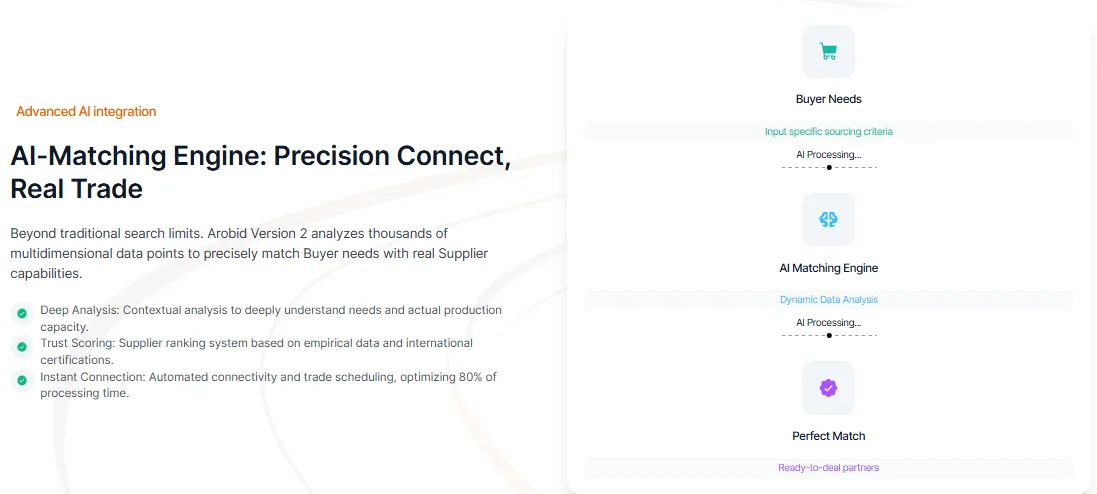
Beyond visibility, the infrastructure integrates a partner search and matching system powered by multi-layered data analytics. Rather than waiting for random interest, businesses are recommended suitable buyers based on industry, scale, target market, and transaction history. This matching mechanism enhances connection accuracy, shortens search time, and increases conversion probability.
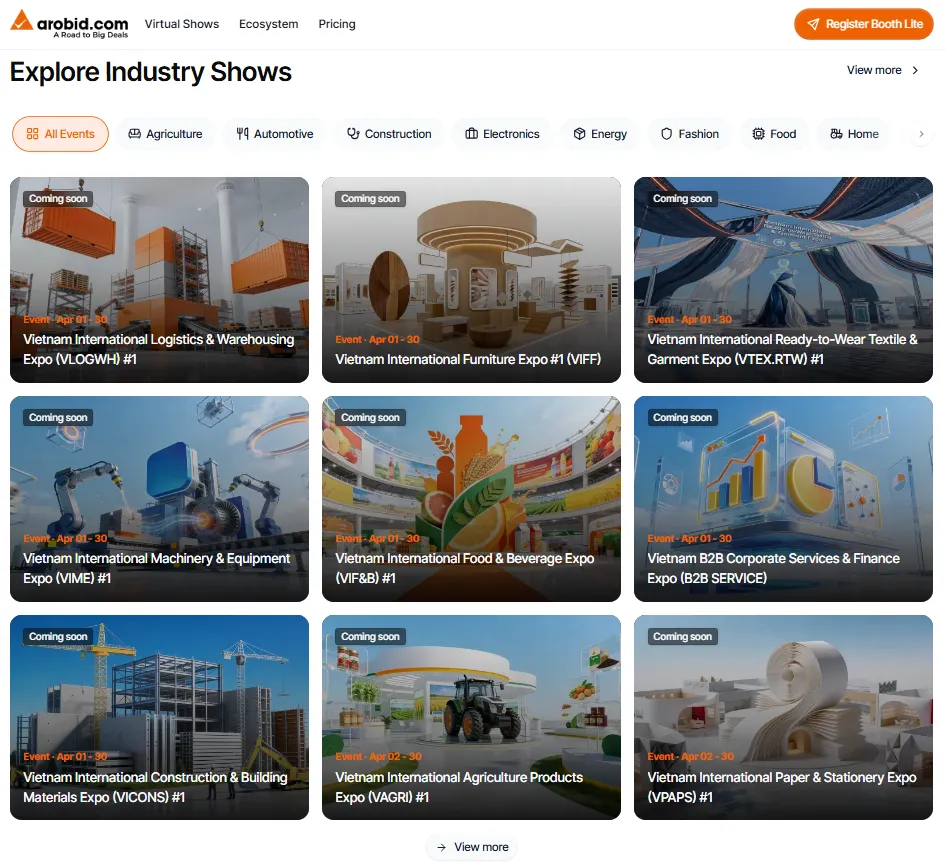
At the same time, the ecosystem of sector-specific exhibitions is expanding rapidly. In 2026 alone, more than 120 specialized online exhibitions are scheduled, creating continuous opportunities for engagement instead of a few isolated highlights throughout the year. Businesses are no longer dependent on a single annual fair but can participate in multiple specialized environments aligned with their market strategies.
More importantly, all platform activities are recorded and analyzed. Enterprises can track visitor traffic, product-level interest, interaction duration, and originating markets for connection requests. Data is not merely for reporting—it becomes the foundation for content adjustment, product information improvement, and market reorientation.
When trade promotion operates on a data foundation, it can be systematically optimized. And when continuously optimized, online exhibitions cease to be time-bound events and instead become a sustainable operational component within a company’s long-term market development strategy.
Advantages for Small and Medium-Sized Enterprises
Within Vietnam’s economic structure, SMEs account for a large proportion but often face budget constraints when participating in international fairs. Costs related to booth rental, sample transportation, travel, and accommodation can be significant barriers.
Online exhibitions drastically reduce these fixed costs while opening access to global markets with more reasonable resources. More importantly, businesses can maintain long-term presence instead of relying on a single exhibition cycle.
This represents a shift in mindset—from spending on an event to investing in a digital asset that accumulates value over time.
A New Role for Trade Promotion Agencies and Industry Associations
Not only businesses, but also trade promotion agencies and industry associations, have the opportunity to reposition themselves. Rather than organizing fragmented events, they can deploy national or sector-wide online exhibitions operating year-round.
Data collected from the platform enables market trend analysis, identification of high-potential industries, and measurement of enterprise support effectiveness—aligning with the objective of forming a digital trade promotion ecosystem where data underpins policy planning.
When Trade Promotion Becomes Infrastructure
Economic history shows that every major leap forward is associated with new infrastructure: seaports for maritime trade, railways for industrialization, telecommunications networks for the knowledge economy. In the digital era, trade promotion infrastructure must likewise be digitized.
Online exhibitions on TradeXpo are therefore not merely a technological solution. They represent a strategic transition—from event-based models to system-based models; from unmeasurable activities to data-driven governance; from short-term presence to continuous operation.
In an increasingly fierce global competition, advantage will not belong to businesses that shine only during a few exhibition days, but to those capable of leveraging digital trade promotion infrastructure as a long-term strategy. When trade promotion becomes a cumulative digital asset, enterprises not only expand transaction opportunities but also strengthen sustainable positions within global value chains. This reflects the core spirit of the national digital transformation strategy: transforming technology from a supporting tool into a foundational force that elevates the competitiveness of both businesses and the broader economy.
Technology



.png?width=1920&quality=90)