 English
Measuring Trade Promotion Effectiveness in the Digital Era: Which Metrics Truly Matter?
Global commerce is rapidly shifting to the digital environment. According to Statista, global retail e-commerce revenue is projected to exceed USD 7.4 trillion by 2025. However, the scale of online B2B transactions is significantly larger. Estimates from Statista and Grand View Research indicate that the global B2B eCommerce market has surpassed USD 20 trillion and has maintained double-digit growth rates in recent years.
In Vietnam, according to the Ministry of Industry and Trade, the e-commerce market is expected to reach approximately USD 31 billion in 2025, accounting for nearly 10% of total retail sales and ranking among the fastest-growing in ASEAN.
These figures reflect a transformation in transaction channels. However, the way trade promotion effectiveness is measured has not shifted accordingly. In practice, many trade promotion programs are still evaluated using familiar indicators such as the number of events organized, the number of participating enterprises, total connection counts, or the number of memoranda of understanding signed.
While these indicators reflect operational scale, they fail to answer a more critical question: how much economic value has promotional investment actually generated in terms of convertible opportunities?
According to CEIR (Center for Exhibition Industry Research – United States), nearly 46% of companies participating in exhibitions struggle to measure post-event ROI. This suggests that the challenge lies not in organizing activities, but in tracking and analyzing effectiveness afterward.
Changes in Buyer Behavior and Measurement Approaches
According to Gartner, 83% of the B2B purchasing journey occurs before buyers engage directly with a sales team. On average, a B2B purchase decision involves 6–10 individuals within the same organization.
McKinsey reports that approximately 70% of B2B buyers are willing to conduct transactions or digital interactions if the experience is convenient and transparent.
These findings indicate that buyers proactively research, compare, and shortlist options at an early stage, and that much of the decision-making process occurs before formal meetings take place.
Therefore, if a trade promotion system cannot track behavior prior to direct engagement, a significant portion of opportunity formation remains outside measurable scope.
Three Levels of Measuring Trade Promotion Effectiveness
To evaluate effectiveness comprehensively, three levels can be distinguished:
Level 1: Operational Scale
This is the most common level, including metrics such as number of events, booths, and participants. While easy to quantify, it merely reflects vibrancy and organizational reach.
Level 2: Conversion Effectiveness
At this level, key indicators include:
- Percentage of standardized enterprise profiles
- Percentage of buyers demonstrating substantive interest (RFQs, technical document downloads, meeting requests)
- Conversion rate from interest to in-depth engagement
This is a critical measurement layer, as it determines the alignment between supply and demand. According to B2B marketing reports (MarketingSherpa, HubSpot), the conversion rate from initial leads to qualified sales opportunities typically ranges between 10–15%, depending on the industry. This implies that most connections do not automatically become real opportunities.
Level 3: Commercial Value
This is the decisive level, including:
- Total pipeline value generated
- Opportunity-to-contract conversion rate
- Average time from initial contact to agreement signing
- Promotion cost per qualified opportunity
According to Forrester, the B2B purchasing cycle can last from three to twelve months, or even longer in complex industries. Therefore, evaluating effectiveness solely during the event timeframe rarely reflects final outcomes accurately.
Five Metrics That Capture the Entire Opportunity Journey
From these three levels, five systemic indicator groups can be identified:
1. Supply Diversity Within Each Industry
In B2B markets, purchase decisions are rarely based on a single option but rather on comparison among alternatives. An effective promotion system must ensure sufficiently broad and diverse supply within each sector.
Diversity includes:
- Scale segmentation (SMEs, large enterprises, leading corporations)
- Variations in production capacity
- Compliance with international standards (ISO, HACCP, BSCI, FSC, etc.)
- Price segmentation and target markets
- Cooperation models (OEM, ODM, private label, etc.)
When supply diversity is adequate, buyers can compare alternatives within the same ecosystem rather than searching across fragmented channels. This reduces search costs, accelerates decision-making, and increases the likelihood of forming commercial opportunities.
However, scale is a foundational condition—not a result indicator. Its impact materializes only when accompanied by subsequent measurement layers such as profile quality, interest levels, and actual conversion rates.
-min.png)
2. Degree of Enterprise Information Standardization
As most B2B buyers conduct online research before direct contact, the enterprise profile becomes the first screening point.
Clear legal information, transparent production capacity, and verified quality standards determine initial credibility. The proportion of standardized profiles reflects enterprise readiness for international markets.
If information lacks structure or consistency, buyer evaluation processes are prolonged, reducing conversion probability.
This is not an outcome metric but a foundational one influencing all subsequent stages.
3. Substantive Interest Indicators
Not all visits carry commercial value. In digital environments, most viewers remain at the exploration stage. What should be tracked are behaviors demonstrating clear intent, such as RFQ submissions, technical document downloads, meeting bookings, or in-depth capability inquiries.
This marks the transition from awareness to consideration. Without distinguishing between these groups, businesses cannot accurately evaluate promotional effectiveness.
4. Conversion Rate to In-Depth Engagement
Interest alone does not constitute opportunity. Opportunity truly forms when both parties enter concrete exchanges: online meetings, technical discussions, RFQs, or commercial negotiations.
The conversion rate from interest to engagement represents the boundary between communication activity and commercial activity. High interest but low engagement may indicate weak supply-demand alignment, imprecise matching mechanisms, or insufficiently persuasive information.
This metric is crucial in evaluating the effectiveness of intermediary systems.
5. Opportunity Value and Contract Conversion Rate
The final—and most important—indicator is total opportunity value and the rate of conversion into actual transactions. Without tracking these factors, effectiveness assessment remains speculative.
The Role of Digital Infrastructure in Closing Measurement Gaps
One limitation of traditional trade promotion is fragmented and discontinuous data. Enterprises participate in short-term events, while opportunity tracking extends for months.
A properly designed digital trade promotion infrastructure can integrate data across the entire lifecycle: recording interest behavior in real time, tracking stage-by-stage conversion, and analyzing opportunity value by industry and market.
In this context, Arobid Version 2.0—a digital trade and investment promotion infrastructure integrating a global B2B eCommerce platform—is being developed along this direction. The system standardizes enterprise profiles through AI, records multi-layer interaction behavior, and continuously tracks connection retention and opportunity progress within a unified data infrastructure.
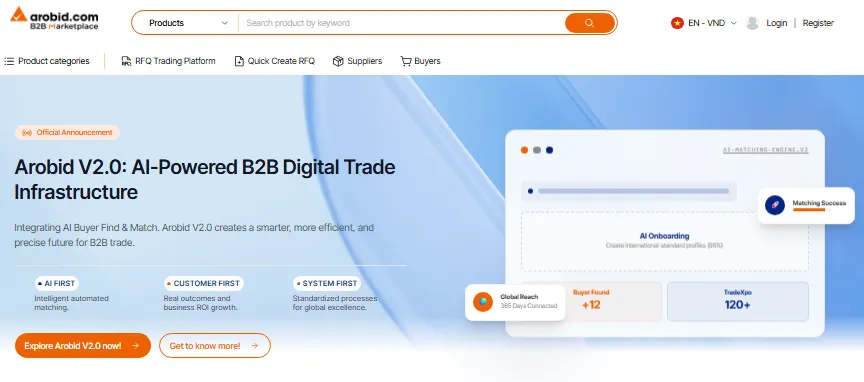
From an analytical perspective, the value of this model does not lie in isolated technologies, but in its ability to integrate the entire promotion journey into a unified measurement system. However, ultimate effectiveness still depends on reconciling system data with actual commercial outcomes.
>>> Learn more about Arobid Version 2.0 here.
Digital Transformation in Trade Promotion: A Governance Challenge, Not Merely a Technological One
Digital transformation in trade promotion is not simply about moving trade fairs online. Its core lies in shifting management thinking—from “how many activities are organized” to “how much measurable commercial value is created.”
As global competition increasingly depends on data and rapid decision-making, the capability to measure and optimize promotion effectiveness will become a strategic advantage.
In that context, data serves not merely reporting purposes but becomes a governance tool—enabling enterprises and trade ecosystems to allocate resources more efficiently and increase the probability of converting opportunities into tangible economic value.
Business




May 7, 2025
May 7, 2025